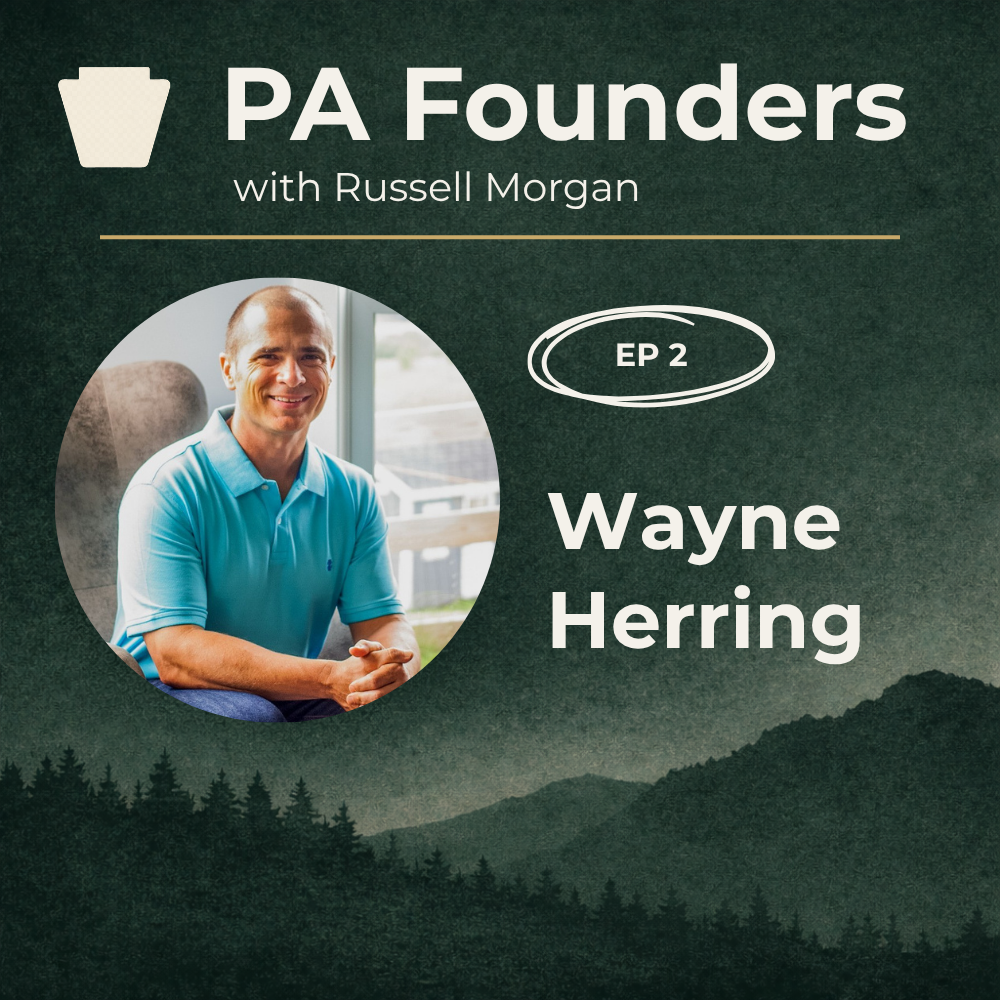
Wayne Herring’s family has been rooted in the same stretch of rural Pennsylvania since before the Revolutionary War. His grandfather was a coal miner. His dad started a service contract company out of a used car dealership. Wayne himself became a civil engineer, realized he hated sitting behind a desk, and ended up in the family business selling warranties across half the country. When they sold the company in 2013, he had a decision to make: keep traveling, or plant his feet on the farm he’d built and figure out what came next.
What came next was Business Builder Camp. Wayne had spent years learning from a mentor named Warren Lewis, a Sandler sales trainer from Palmyra who poured into Wayne through one-on-one coaching, back patio conversations, and phone calls where Wayne would say, “I don’t know what I’m doing. What should I say next?” Warren passed a few years ago, but his influence runs through everything Wayne does now: coaching business owners through masterminds, one-on-one work, and live retreats where the setting is as intentional as the conversation.
This episode is a window into how Wayne thinks about creating environments where people actually change, not just feel inspired for two weeks. We talk about the difference between real vulnerability and the performative kind, why he chose a county park lodge with a stone fireplace and a waterfall over a conference center, and what it looks like when a mastermind group matures to the point where the members can run it without him.
About Wayne
Wayne Herring is the founder of Business Builder Camp, where he combines small group masterminds, one-on-one coaching, and outdoor retreats to help business owners create lasting change. Based in Schuylkill County, PA, he’s been coaching since 2013.
Topics we cover
- Wayne’s Pennsylvania roots and how he went from civil engineering to coaching
- The mentor who shaped everything: Warren Lewis of Palmyra
- Why labeling your work as “coaching” vs. “consulting” vs. “mentoring” doesn’t matter
- The Prosperous Coach approach: serve first, let people experience the work
- How Business Builder Camp’s ecosystem works (one-on-one, masterminds, campfires, Rendezvous)
- Building trust and vulnerability in a room of business owners
- How physical environments shape the way people think and create
- What a behind-the-scenes tour of an NFL facility taught Wayne about culture
- Making a two-day retreat produce lasting change, not just a temporary high
Links and resources
- Business Builder Camp
- Wayne on LinkedIn
- The Prosperous Coach by Rich Litvin and Steve Chandler
- Rendezvous Event: May 20-21, 2026
Transcript
Show full transcript
Do you remember when yo mama jokes were a thing in school? Because with today’s guests, I feel like I’ve got a version of one of those. But instead of it being yo mama so dumb, it’s yo mama so Pennsylvania. And so how Pennsylvania is today’s guest, Wayne Herring. This morning I had Scrapple for breakfast. If you’re like me, you don’t know what Scrapple is. So listen to the end for a true Pennsylvania’s explanation and you can punch your keystone card for the day. But all that aside, Wayne runs Business Builder Camp. He helps business owners through coaching, community, and mastermind groups. And he’s just energizing to listen to. And that’s not coming from a frantic or nervous energy. It’s nothing like that. But from the way he carries himself, he embodies this openness and mindfulness. And it makes every conversation feel like a deep talk late into the night around a fire pit. If you’re interested in energizing your team or your people, I think you’re going to get a ton out of this episode.
But let’s start at the start and hear about Wayne’s Pennsylvania roots.
Wayne: The Herrings came to this area where I live back before the Revolutionary War. And my family, for the most part, hasn’t left this area. I left for a while, but came back. And so we, of course, were not the first inhabitants of this land. There were other people long before that. However, in terms of European settlement, yep, my family has been here for a long time, right down the road. And the names are on the tombstones of the local cemeteries. So family grew up right around here. My grandfather was a coal miner, which was common around here. And I grew up with him. And so in my building, I’ve got photos of coal miners and a miner’s hard hat and headlamp like he used to wear. And those things are part of who I am, I believe. The farming, the coal mining, the fact that my family does have agricultural roots right in the area, all part of me.
But what got me to Business Builder Camp, my current business, which is taking business and life coaching and creating community around it, would be the short way to say what Business Builder Camp is all about. My journey was through construction and getting into sales. I was a civil engineer, but I preferred the sales and project management part of it and did some of that in Colorado. I started my career out there because I love the mountains and I love, you can see there’s photos behind me here of my son and I in Colorado. And he just landed a job working as a horse packer and guide in Colorado, which is a dream I had when I was young.
So I started out there, came back home, realized I didn’t really like office civil engineering. And so I was considering taking a job selling cement because that commission sounded like a good way to be rewarded for your efforts. And it sounded like a good way to get out of the office and not be stuck behind a desk. And when I talked to my father about my plan, he had a business. I have other entrepreneurs in my family. And so when I talked to him about that as a mentor, he said, if you’re going to go into sales, why don’t you join the family business? And so I did. I was really uncertain about that. Spent two months talking with my dad about if this was a good idea to be Wayne Jr. And rather than being independent guy doing his own thing where nobody knew there was a Wayne Sr., but ultimately we did work together.
When I was there, I fell in love with personal development and organizational organization, cultural change and sales training. I had a mentor whose name was Warren Lewis. He’s from Palmyra. His name is, or his family name is still on the Click Lewis family of dealerships in Palmyra, now run by his grandson, Patrick. Warren was a great mentor, teacher. I had never even heard of business coaching or sales training until I met him, but he poured into me. I, in turn, tried to serve people on my team and read lots of books and all these things.
And eventually when we sold dad’s company in 2013, I decided not to keep traveling because by then I’d further rooted into the ground, had an organic farm going and had four kids and had just spent a lot of time traveling and decided I did not want to help expand the company from half of the U.S. to the rest of the U.S. And I thought, what am I going to do if I’m not a VP of sales of this company? And the farm was great, took a lot of time. It wasn’t going to pay the bills, the mortgage. So I thought I want to be like Warren Lewis.
And he served as a mentor and helped me get started. And it was much like a master and apprentice type of relationship, like we might see in the trades. Warren helped me, Warren gave me lots of advice. I spent a lot of time on his back patio with he and his wife, Penny, and met for coffee lots of times and lots of phone calls to say, I don’t know what I’m doing. What should I say next? And he was such a blessing. He passed a few years ago. But his kids and family are still very important to me. And I have a lot of gratitude for him and his family. So that’s how I got started coaching and consulting back in 2013.
Russell: How did you meet Warren? Was he providing sales training or something to the company that you were at?
Wayne: Right. So my dad had founded Preferred Warranties, which is still a going concern, in 1992. And my dad was a farmer, U.S. Army trained mechanic, steelworker, whatever he needed to do. But he used to read Wall Street Journal articles and wanted to have a business someday. And he had a couple of businesses that were in the auto mechanic type industry. And they worked fine. And then he was a used car dealer. But he eventually then started Preferred Warranties out of his used car dealership. It was a service contract, or is still a service contract company.
And dad was a believer in getting outside help and having advisors and not going it alone. And so he went to, I think he went to a Sandler sales seminar that Warren was putting on. Warren was a Sandler selling franchisee. And dad ended up hiring Warren to do that. When I came into the company, he introduced me to Warren because he very wisely knew that I’d be more likely to listen to somebody other than him at times. And that it would be helpful to have an emotionally intelligent advisor who was working with both of us, and it certainly was very useful.
And then, yes, Warren Lewis was providing sales training, management training to my team. And part of my story is I got sober in 2007. And when I did, after that, I think a whole new chapter of growth opened for me. I could see things more clearly. And I was 32, 33 at the time, looking for more direction. I expressed some of that to Warren. And he said, you know, I also do one-on-one executive coaching. I would call it business and life coaching, like what I do now. And he said, if you would like to do a series of very intentional conversations with me about the path ahead and about your growth and about what holds you back, I’d love to create that with you. And so I did do that work with him and, again, fell more in love with it. But that’s how I met Warren, was an introduction through my dad.
Russell: There’s so many things that I could ask there. But I think what might be interesting to the listener versus me is that somebody who, I would consider you an expert in coaching and advising people. How would you outline the difference between mentoring somebody, coaching somebody, and then maybe acting as a consultant or something like that for somebody?
Wayne: Warren Lewis and I had these conversations, actually, when I got started. Because if you were to go to an ICF coaching school, they would tell you they’re different. And if you work with maybe a marketing advisor, they might tell you, you need to get this clear. And I’m sure those things are true. I saw something from a friend of mine, Don Angelo Bivens, who’s an executive coach. And he signed off on the video by saying, remember, what I say is not necessarily the truth, but I do have a perspective. And I’m paraphrasing. That’s roughly what he said.
I’m sure that it is true in certain spaces. There’s a reason why you’d want to separate those. But my point of view is, who cares? It doesn’t really matter. And as I would talk to Warren about that, because I thought it mattered, that this matters. There’s a lot of things I thought mattered because somebody told me it did. And he said, Wayne, what I would say is, I do coaching, consulting, counseling, and ongoing reinforcement training. And he said, but I help people. I don’t know. I listen. I ask questions. I find out what they’re trying to create, and then I help people.
And so there are coaching modalities that you could become a question-behind-the-question certified coach, or you could become a co-active coach. You could get certified in these different coaching modalities. And those schools and the people in them are often going to be pretty even militaristic about, you should never give people advice. You should just ask questions that make them think. And if that’s what serves you at the moment as a client or as a human on the journey, then I think you should go get that. I personally dance in between all those.
Russell: And so for the benefit of the listener, then, perhaps if you’ve interacted with a coach in the past, and it’s felt almost like I’m a square being shoved through a circular hole, perhaps there could be a bunch of things happening. But one of the things that might be happening there is something like that, somebody trying to conform the client’s needs to their specific methodology.
Wayne: It certainly could be. And I have friends that are staunch ICF coaches or very firmly in the Entrepreneur Operating System franchise, and they help a lot of people. So that’s the thing. I don’t think my way this way is right or wrong. I just, for me personally, you don’t have to separate it.
Along the way, Warren Lewis never wrote a book. He wasn’t an official coach for coaches. He didn’t have a coaching school or any of those things. He just mentored me, and he had a couple other people in retirement that he would speak into their lives and their work. He continued doing that even after he wasn’t getting paid for it.
Probably somewhere around 2016, 17, a friend of mine who’s a coach gave me a book called The Prosperous Coach. And The Prosperous Coach, if you were to go look it up right now, often sells on Amazon for $60 to $80 for the book. It is not cheap. And it primarily has spread by word of mouth because it’s just so good. And The Prosperous Coach was written by Rich Litvin and Steve Chandler. And when I read The Prosperous Coach, I was like, oh, Warren Lewis probably could have written this or is very close.
And so I have been to Rich Litvin’s coaching intensives, very helpful. But in particular, I then went to Steve Chandler’s Coaching Prosperity School. And I was in one of the last seven-month cohorts to do that school live. And Steve’s way is very, the Prosperous Coach way, is like, I have conversations with people that are possible clients of mine. We just have a conversation because it’s helpful. I don’t want to make it sound like every conversation I have is intentionally aimed towards creating a client. They’re not.
But if I’m talking to somebody who I know coaching may serve them, I follow The Prosperous Coach approach. And it’s like, serve abundantly for free, create an experience of my coaching, my unique way of doing that for that client, which is a blend of mentoring, coaching, consulting, whatever you might label it, but let them experience it. Do the work with them. Do it without reservation.
It’s not uncommon for me to have two 90-minute conversations with a potential client and another 30-minute conversation and send them some things on email. And they may not become a client today, or they might, or maybe they’ll become a client down the road. But my way of doing this is don’t talk about, it’s like fight club. Number one rule of fight club, don’t talk about fight club. Number one rule of coaching like this, don’t talk about coaching because nobody cares. You can’t sell coaching in my world by talking about it. You can only just help people, serve people. And then at some point, you got to say, look, here’s what it looks like to work with me. We’re going to work together in this fashion. You’re going to pay this much. Here’s how you’re going to pay it. But they have to experience it.
Russell: Say some more on that then. How do you describe Business Builder Camp in a more fleshed out way?
Wayne: It starts with, I work with business owners who I call business builders. I believe that building a business is like being an artist, but instead of having paints and a palette and a canvas, business builders create by perhaps writing, typing, verbalizing, vision, and plans. They put together operating procedures, slide decks at times so other people catch the vision. They put together job descriptions. They hire people. They design a workflow. They try it themselves. They go do plumbing work, but then they figure out how they can get a van and a competent technician and have them do that same work to the same standards, right? So business building is like building a building or being an artist.
So Business Builder Camp starts with who it is we work with. They are business owners, just that I look at it through this lens of they’re building the whole system and they’re building something. A business is outside of them. They may work in the business. They may be employed by the business, but the business becomes a living, breathing thing, a creation.
So at the core of it is that, and then at the core of it, my part is to be coach, consultant, mentor. But at some point I realized I wanted to go beyond business coaching one person at a time and I wanted to start creating spaces for business builders to gather where there would be vulnerability and trust in the room.
So I’m sitting in my office here at the farm and I’m in a room, there’s a whiteboard, there’s a table here, there’s enough space to get about 15 people here if I were to gather them in a circle of chairs. More often though, like my masterminds, so part of Business Builder Camp are weekly masterminds. Those are rooms like this where there are six to eight business owners gathered, business builders gathered, trust and vulnerability, and then there’s community. They get to know each other and they know each other over a long period of time.
I work to be the filter on who’s in the room. I work to be the one to make sure that the room is curated in a way that everybody gets a chance to speak, everybody listens. I help give the idea of operating that room such as, hey, let’s write down in our journal what Fred said this week so we can ask him about it in the future and be his accountability partner.
So my coaching went beyond the one-on-one to a room of eight like that, six to eight like that, whether physical or on Zoom. And then Business Builder Camp is the larger ecosystem of mastermind groups. So now you take a group of six to eight and another group of six to eight and another group of six to eight and they make up the whole camp ecosystem along with some of my one-on-one clients who also are known to the group along with some people who maybe only show up every year at our Rendezvous event because they want to come have a two-day growth experience and they’re not quite ready for a weekly mastermind, but those two days set the tone for the rest of the year.
Russell: The trust and the vulnerability aspect, most of us have been in rooms where there’s kind of like phony vulnerability. They’re not actually bearing the 5% that’s really great that they wouldn’t show to anybody else, the 5% that’s really miserable that they wouldn’t show to somebody else. It’s somewhere within the comfy 90% range, but portrayed in a way to make it false and it kind of can just, for me, it always like suck the oxygen out of the room. How do you think about building trust and vulnerability, whether it’s from curating people to the ongoing rituals and practices?
Wayne: I’m the filter for who’s in the room. I don’t always get it right, but pretty close. Like we’re pretty close to people who are able to get a handle on ego and be able to suspend negative ego influences for a period of time while they’re with others. I talk to everybody before they join. I’m purposely keeping it pretty small. I’m enrolling people for our Rendezvous event right now. And I’m talking to everybody like old school on the phone most of the time. So that’s part of the filter, how I help people make sure it’s the right room for them.
And then I think partially through my recovery from alcoholism stuff, which I say openly and I talk about to people, I’ve become more able to be vulnerable myself and lead with vulnerability. It’s a work in progress, Russell, and I made lots of mistakes, like raising kids or in my prior marriage, in my current relationship with Ivy, my fiance, I make mistakes. But I tend to try to take inventory at the end of the day. I try to be self-aware of my own thoughts, words, actions, see where it’s not congruent with who I want to be. And I’ll talk openly about that with clients and with people in the room. Like I’ll talk about my own stuff, my own awareness, my own places where I had to rewind something and say, I’m not happy with how I handled that.
And when I do that, I think it encourages other people to dip into the 5%, which was a great way of describing that right there, the 5%. And you’re right. We often think of the negative stuff, like people don’t want to talk about the negative stuff, but there’s the good stuff too, that we’re conditioned socially to not take a look at inside of us and speak openly about. We don’t run around going, I’m so awesome. We just don’t do a good job taking a look at that.
So I try to help people look at that. That is part of my role in the room. If we’re running a mastermind to pick up on subtleties that allow me to say, I think there’s more there. Like somebody who’s talking and I’m going to say, I think there’s a little bit more there, good or bad. Like, what did you do right in that situation? Let’s not move past that so quickly. Let’s take credit for that good thing you did, not for the sake of making you a rock star, but because it’ll serve you to really look at it and identify what you did right or what was different, and then it could help other people be inspiring to them.
And then, I talk a lot about, like, we’re in this room not to compare, we’re in this room to be inspired. But then when you say that, it’s one thing to say it, it’s another thing to sit with that. It’s another thing for me to verbalize to people, like, I totally compare myself to other people, or the thoughts occur to me, the thoughts occur. It’s whether I chase that thought, whether I honor it, what I do with it. So there’s a lot of working like that.
I have sidebar one-on-one conversations with people, sometimes to ask questions and help them see things, or sometimes because I don’t know what’s going on. How dare I also think I know what’s going on for them? I ask questions sometimes to try to understand. And if I have, there hasn’t been a lot of this, but a handful of times somebody is, I think, going in a direction that’s not helpful to the whole group, and then I would have a conversation with them knowing full well, they might say, well, screw you, Wayne, like, I’m done. Like, don’t charge my credit card next month. The group has to be more important than the individual line item in my income for the month.
Russell: You mentioned your farm and that you bought an organic farm. What do you think about literally being in different environments and how it changes people’s brains? What’s your lived experience around that?
Wayne: People come here. I know that the drive to the farm, the drive to my place when they’re coming here to do intentional work, the drive can be as important as anything we talk about. The drive here and the drive home. An intentional moving and effort to go somewhere away from your normal comfort zone taps into parts of your creativity and brain that you don’t normally have access to, much like a lot of times good ideas come out in the shower too. There’s lots of places where we open up some new channel within ourselves. So driving here can be good.
The setting of intention, like you’re going to come to the farm and you’re going to have breakthroughs. If I plant that idea in somebody’s mind, I’m no hypnotist but I know that when people are looking for it, it happens more so.
An example for me: I was invited by a guy named Ankush Jain. Ankush is a coach in the UK who also went through the Steve Chandler School. He invited me to a thing he called the Powerful Men’s Immersion. And it was 15 men, entrepreneurs, coaches, consultants, counselors who were invited to a farm in Southern England. The farm was surrounded by beautiful, rolling English hills and woods. It was six days of being there. And again, there was significance to the journey to get on a plane and go to England and then to travel to this farm. All those things caused breakthroughs, ideas that I acted upon. They certainly increased mindfulness, the setting itself made me more aware of my thoughts.
So if you take this fictitious CEO or founder of a manufacturing business, and I say, hey, I want you to come to the powerful, creative manufacturing CEOs retreat in the woods. And you’re gonna have breakthroughs while you’re here. Bring a notebook so you can write it down. And then if they come with the right mindset, that will happen. And then for them, if they get out of the factory and go to a place that allows for them to have more quiet versus the clanking of machinery, they’ll think differently, without a doubt.
Russell: How do you think about environment at the team level?
Wayne: I have a friend who works for an NFL football team. A couple weekends ago, some buddies and I, we all went to high school together, we went to visit him and he gave us a behind the scenes tour of their training and practice facility. They set the environment for those football stars, workers, employees. Everything about it is pissing excellence. High quality furniture with the team logo. It’s the Tampa Bay Buccaneers. High quality furniture. Everything has logos, high quality wood and materials. The room where they get their briefings, you sit down in the chairs and you feel like a football champion.
Water, the life water stuff or smart water, probably made up, like you said, placebo. But what does placebo even mean? Just because it’s made up, don’t make it wrong. Everything about it, first class, photos all through the hallways, large photos of grit, determination, success, winning. Colors dialed in, on brand. A workout facility, spotless.
Most businesses are not an NFL team and they probably don’t have the cash and the profit to be able to do some of what I saw there. But I do see business owners making an effort to have the best lunchroom they can have for the people who are working in the business. And we always say, well, it seems like they take it for granted. Well, I don’t know, maybe. But what are you looking for? Are you looking for people to come up and give you all these thanks and praise? Is that what it was about or was it about serving them and then in turn, they serve the enterprise and the business?
Russell: Can you say more on that through the lens of you running Business Builder Camp? How do you think about those moments or experiences?
Wayne: Thank you for the question because what I’m sitting here thinking is I’m probably not intentional enough about it or I haven’t been up until this point and that can change right now. And there are things that I do to create an environment and experience for people. I already do some of those things but I could do it even more intentionally and so I appreciate you asking me the question.
If anybody listening hears your question to me about what do I experience so that when my clients walk into the room, they feel powerful, they feel creative. If everybody listening could hear that question, not from you to me, but rather from you to them, they’ll instantly be able to sit and think of the whole experience and put themselves in the shoes of the folks walking through the door. And when you do that, things become obvious and apparent.
For me personally, it’s more of a system. You asked me that question and I allow you to put me in the hot seat, essentially. I’ve heard it called the clarity chair. So in any conversation I’m having, even though it’s supposed to be that you’re asking me questions like I have something to share, instead of that, I’m willing very quickly to say, Russell has something for me, his question has something for me, I’m gonna sit in this.
So the event we’re having in May, Rendezvous, where we’re 50 business builders in one room, the venue was chosen intentionally. It’s a place called Sweet Air Lake County Park and it is not the Ritz Carlton of Beaver Creek, Colorado. That’s cool, amazing, go to Ritz Carlton and have a retreat, that could be amazing, it’s not that, but it’s a little bit of that. It’s an old lodge that has a stone fireplace, has hardwood floors, has exposed rafters, has a big front porch that looks out at the County Park Lake, which in New England they call it a pond. And it has a walking trail that goes along the lake and along the walking trail are places to sit and pause and stop and think and there’s a waterfall. I chose that venue intentionally.
Over the next 60 days, I will go there a couple of times. I’m a feeler, I gotta feel it, I gotta walk there, I gotta be there and I’m thinking of the event we’re curating as I walk there, as I’m there, I’m thinking about the people walking in the door. We’re ordering tablecloths right now that are black. Everybody will get a gift and everybody will get a high quality journal to encourage them to write things down. Just putting yourself in their shoes, I think is part of what we do.
Russell: How would you describe Rendezvous in a bit more depth? And how do you make a two-day retreat into something that gives somebody a longer tail of energy than just the two week bump?
Wayne: In order to answer what is Rendezvous, I just have to quickly go through the ecosystem of Business Builder Camp. There’s levels of engagement. I’ve got one-on-one clients that I’m working with most weeks, that’s a pretty big level of commitment and contact. We have our weekly mastermind groups, which right now we run men’s mastermind groups. The reason I keep it exclusively men is I like talking in those groups about being a husband and being a father, some of the unique ways that the male brain works.
Rendezvous sits next to that in that it’s two live days in May and people could come back every year. Below Rendezvous is weekly virtual campfires that we’re running right now, that’s on Zoom and it’s pretending we’re around a campfire. How would we all chat if we were around a campfire? We always invite a storyteller to come who is a business owner, who is gonna share their story of building their business, the good, the bad and the ugly, or it’s an expert who’s gonna teach about something and then be available to answer questions and have an intimate campfire conversation.
Rendezvous, you come into a room, there’s 50 people there, you’re taking two days out of your life, out of your business to say, I am going to work intentionally on what I’ve built so far, where I’m headed next. People write out a strategy one-page sheet. They take a look at and get clear on their three-year vision as best they can see it now. They work on 12-month goals, getting clarity around that and they take a look at creating priorities or projects which comes from Rockefeller Habits. People build a one-page strategy plan, they get around other business owners, they have time in the hot seat with a small group of five other business owners where they get to play around with this idea of other people are paying attention to me, pouring into me, helping me.
And so people, what I wanted to create is they could come once a year to that thing and they could get a lot of clarity, a lot of problem solving. They can relax and rest a little bit because they can go sit on a bench by the water. But then to your point about lasting change, if they join Mastermind, they’re going to be in a small group and every week they’re going to be on Zoom and it’s more my responsibility as the creator of Mastermind to help keep them going and keep the change proceeding.
But if they come to Rendezvous, we make it possible through the community that they, with a little bit of initiative on their part, they can keep it going. They’re in our Facebook group for a year and it’s not huge, it’s not one of these things where there’s 500 people or 1,000 people. The people in our Facebook group are everybody in that ecosystem. It’s my one-on-one clients, it’s the Mastermind members, and it’s anybody who attended that event. There’s 60 people in there and you can take the time on your own to reconnect with folks and they will help you. And through the virtual campfire, you have access to the community every week so that you can stay on course.
Russell: What are the dates of the Rendezvous for anybody who’s listening?
Wayne: May 20th and 21st, 2026. And I’m sure if somebody listens to it, we’ll do similar dates in 2027.
Russell: Wayne, if somebody listens to this and they wanna reach out to you, how should they do so?
Wayne: They certainly can find everything they need at businessbuildercamp.com. So all smashed together, businessbuildercamp.com. I’m on LinkedIn. If you look up Wayne Herring, you’ll find me there. I use LinkedIn a lot. I appreciate messages there. So that would be a good place to contact us too.
Want to be on the show?
If you're a founder or business owner in Central PA with a story worth telling, we'd love to hear from you.
Schedule an Intro Call